Federated Learning (FL) is widely celebrated as the privacy-preserving future of distributed artificial intelligence. By keeping raw data on local devices and only sharing model updates, it naturally complies with strict data regulations like GDPR. However, as 6G networks push intelligence closer to the edge, researchers are realizing that basic Federated Learning is not a silver bullet.
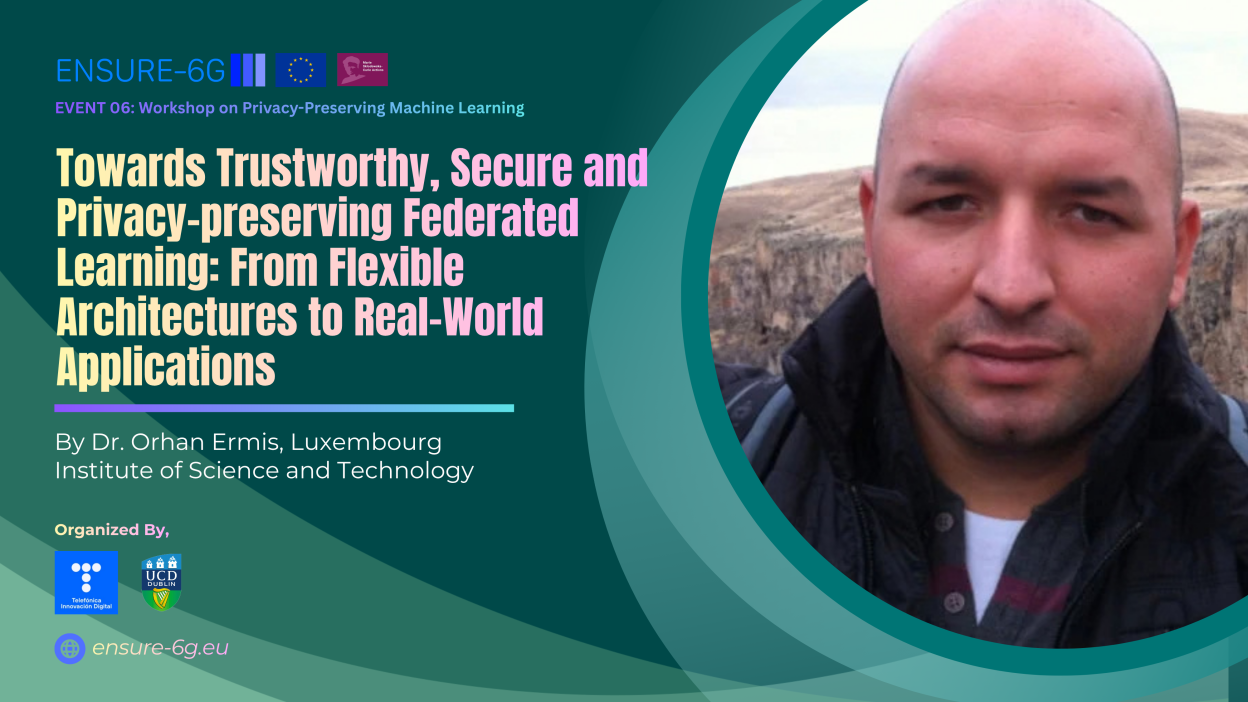
In Talk 05 of ENSURE-6G Event #6, Orhan from the Luxembourg Institute of Science and Technology (LIST) presented an in-depth look at Trustworthy, Secure, and Privacy-Preserving Federated Learning. The presentation outlined the evolution of privacy in machine learning and introduced two robust frameworks designed to patch the remaining vulnerabilities in distributed AI.
The “Three-Faced Dilemma” of Privacy
Years ago, securing centralized machine learning relied heavily on cryptographic primitives like Homomorphic Encryption and Multi-Party Computation. While mathematically secure, these methods introduced massive overhead, forcing developers to balance a “three-faced dilemma”: Accuracy vs. Efficiency vs. Privacy.
Federated Learning largely solved the efficiency problem by distributing the computation. However, iterative model updates sent from clients to an aggregator can still leak sensitive information over time. A “curious server” analyzing these continuous updates could potentially profile a client—inferring demographic distributions, health statistics, or corporate structures—without ever seeing the raw data.
ATLAS-FL: Adaptive, Trustworthy Learning and Aggregation
To secure this communication, the LIST team developed ATLAS-FL (Adaptive Trustworthy Learning and Aggregation with Security for Cross-Silo Settings).
Designed to be highly versatile, ATLAS-FL supports both Horizontal splits (where clients have the same data structure but different samples) and Vertical splits (where clients hold different feature sets for the same entities). To achieve true privacy, it integrates two vital layers:
- Secure Aggregation: Uses cryptographic masking so that the server can only see the final, aggregated global model, completely hiding individual client updates.
- Local Differential Privacy (LDP): Injects mathematical noise directly into sensitive local datasets before training even begins, guaranteeing that the absence or presence of a single individual’s data cannot be inferred.
The ATLAS-FL framework was successfully validated on real-world use cases, including predicting public transportation ridership using Bluetooth and drone data in Helsinki, and detecting phishing threats in corporate emails using Gated Recurrent Units (GRUs).
MultiTrust-FL: Guarding Against Malicious Clients
While ATLAS-FL protects the client from a curious server, what protects the server from malicious clients?
In large-scale deployments (like mobile applications or distributed IoT sensors), the network must assume that some clients will act maliciously. Attackers might attempt gradient inversion, data poisoning, or backdoor injections to subtly disrupt the global model.
To address this, the researchers proposed MultiTrust-FL, a comprehensive defense architecture that evaluates trustworthiness at every stage of the FL lifecycle:
- Robust Aggregation: Replacing standard FedAvg with robust statistical techniques like Trimmed Mean or Geometric Mean to neutralize extreme, poisoned updates.
- Anomaly Detection: Using similarity metrics to spot and filter out outlier models before they are aggregated.
- Client Reputation: Building reputation profiles for clients based on their historical model updates, ensuring that consistently reliable nodes carry more weight.
Looking Ahead: The Generative AI Challenge
As the framework matures, the next major frontier is integrating Large Language Models (LLMs) and Generative AI into privacy-preserving federated environments. Because these models contain billions of parameters, standard periodic FL updates introduce massive communication bottlenecks. Adapting robust, secure aggregation techniques to handle the scale of modern GenAI is a critical future direction for the research team.
Watch the Full Talk: