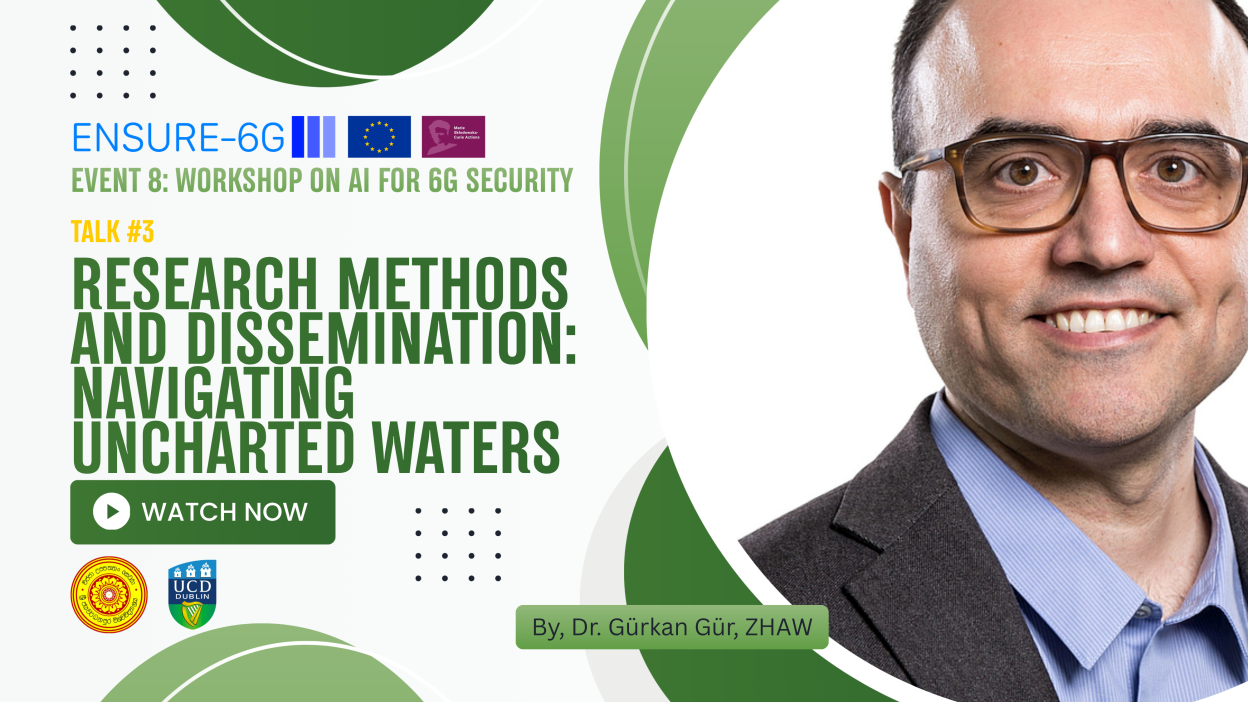
We are thrilled to feature the recording of Talk #3 from our ENSURE-6G Event 8: Workshop on AI for 6G Security, which recently concluded at the University of Sri Jayewardenepura (USJ), Sri Lanka.
In this session, Dr. Gürkan Gür, Senior Lecturer in the Information Security Group at the Zurich University of Applied Sciences (ZHAW), Switzerland, takes a deep dive into the foundational soft skills every engineer needs in his presentation titled “Research Methods and Dissemination: Navigating Uncharted Waters”.
About the Speaker
Dr. Gürkan Gür is a Senior Member of the IEEE and an ACM member with extensive experience leading Horizon Europe and SNSF/NSF projects. His diverse background encompasses future internet architectures, information security, critical infrastructure protection, and active engagement in IEEE standardization workgroups (such as space systems cyber security and V2V communication for unmanned aircraft systems).
Key Takeaways from the Talk
- The Engineering Mindset vs. Traditional Science: Dr. Gür highlights that unlike other branches of science, the primary goal of engineering research is to create new utility or systematically solve a defined problem. Using cyber security as a backdrop, he breaks down the rigorous journey early-stage researchers must take—progressing intentionally from motivation and problem statements to prototyping, evaluation, and eventual dissemination.
- Structuring Science with Design Science Research (DSR): To ensure engineering development is scientific and reproducible, Dr. Gür outlines the formal Design Science Research framework. This model relies on three interconnected loops: the Relevance Cycle (understanding requirements and use cases within human, organizational, and technical environments), the Rigor Cycle (building a grounding knowledge base of scientific theories and expertise), and the central Design Cycle (the iterative building and evaluation of actual artifacts).
- Deconstructing Research Artifacts: The presentation defines the distinct outcomes produced by engineering research, categorizing them into four key blueprints:
- Constructs: Specialized vocabulary and standardized concepts (e.g., zero trust, attack surfaces, indicators of compromise).
- Models: Interactive frameworks that allow systems analysis (e.g., MITRE ATT&CK, STRIDE threat models).
- Methods: Step-by-step Procedures and algorithms (e.g., alert correlation algorithms, encryption processes).
- Instantiations: Practical proofs-of-concept, patches, or working prototypes tested on realistic hardware.
- Choosing the Right Evaluation Method: Creating an artifact is only half the battle; rigorous validation is crucial. Dr. Gür reviews primary evaluation tracks: Expert Evaluation panels, Mathematical Proofs (vital for applied cryptography), Simulations using modern datasets, and hands-on Performance Evaluation on operational testbeds to accurately track physical KPIs like packet loss and latency.
- Smart Dissemination and Literature Hopping: Shifting to the “second act” of his presentation, Dr. Gür shares practical strategies for deconstructing existing bodies of research. He recommends junior researchers practice graph-based “paper hopping” (tracing citation maps up to three tiers deep), maintaining meticulous track of keywords, and strictly capping ultra-relevant reference papers to a manageable group of five to filter out noise.
- Navigating the Generative AI Era Responsibly: Addressing recent developments in academic guidelines (citing 2026/2027 standards like NDSS), Dr. Gür details the ethical boundaries of utilizing LLMs in research. While generative AI is a strong assistive tool, researchers bear ultimate liability for the validity of the text, must completely avoid plagiarism, and are expected to maintain strict transparency by formally disclosing exactly how and where AI assistance was applied.
Watch the full presentation video below: