As part of the ENSURE-6G Staff Exchange program, I recently completed a four-week research secondment at Z-RED L.P, working on the project’s activities related to ethical considerations and trust in multi-agent AI systems for 6G security. The secondment focused on a question that becomes increasingly important as AI systems take on more autonomous roles in future networks: how can we ensure that humans remain meaningfully involved in security-related decisions made by multiple interacting AI agents? My work explored a Human-in-the-Loop (HITL) framework in which a regulated professional acts as a supervisory entity within AI-driven security workflows. Rather than treating human involvement simply as a final approval step, we investigated how human oversight can be integrated into the decision-making process itself, influencing transparency, explainability, interpretability, accountability, and ethical alignment.
During the visit, we looked at how human experts could interact with AI agents through structured feedback mechanisms, decision validation, and reporting processes. We also explored the role of evidence-based grounding in helping human experts understand and validate AI-generated outcomes, with particular attention to traceability and hallucination risks in multi-agent AI workflows. An important aspect of the work was connecting the technical design of HITL systems with the ethical dimension of trustworthy AI, considering concepts such as trust, responsibility, accountability, and oversight. The main goal was to understanding how these principles can be translated into practical mechanisms for AI-based security decision-making in 6G environments.
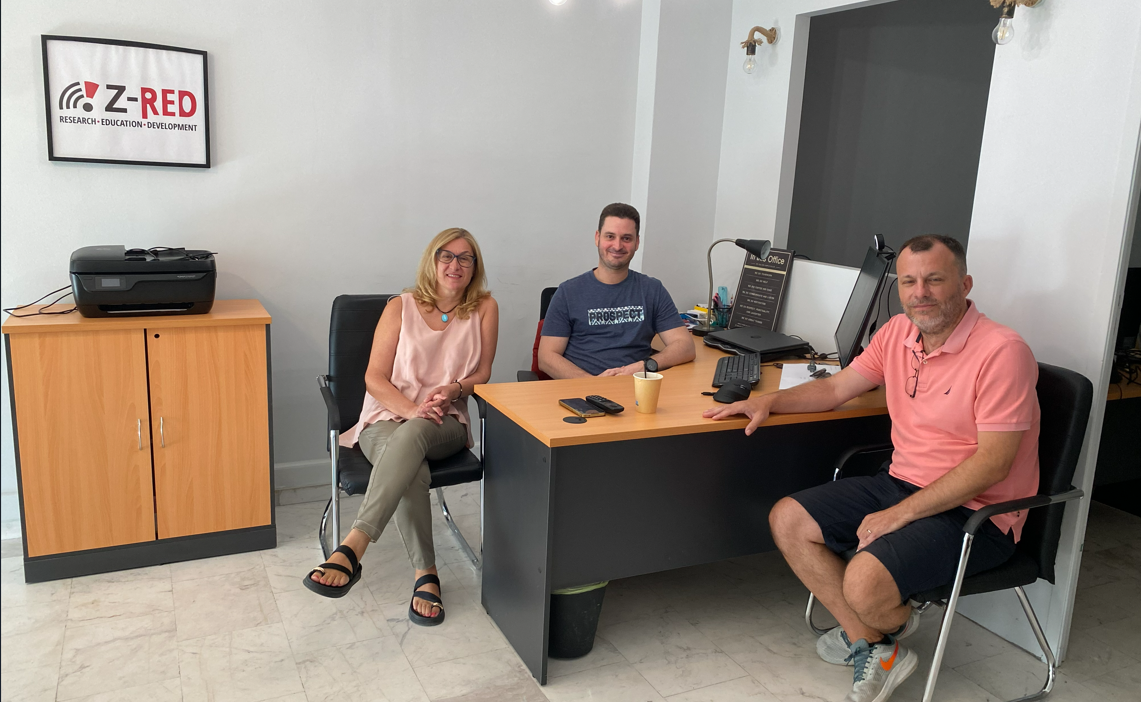
Beyond the research itself, one of the most valuable aspects of the secondment was the opportunity to work closely with the Z-RED L.P team in person. The direct interaction made it possible to exchange ideas continuously, challenge assumptions, and connect different perspectives on AI, security, and future 6G systems. I would like to warmly thank Periklis Chatzimisios and Eirini Kanaki for their hospitality, support, and the many constructive discussions throughout the visit. Their contributions were instrumental in shaping the research activities and identifying directions for continued collaboration. The secondment has provided a strong foundation for further joint research, and opened the door to further collaboration on trustworthy and human-centric AI for future communication and security infrastructures.
Finally, I would like to thank the ENSURE-6G project for making this research exchange possible. Opportunities like this demonstrate the value of bringing researchers from different organizations and backgrounds together to explore challenging problems and turn shared ideas into new research directions for secure and trustworthy 6G networks.