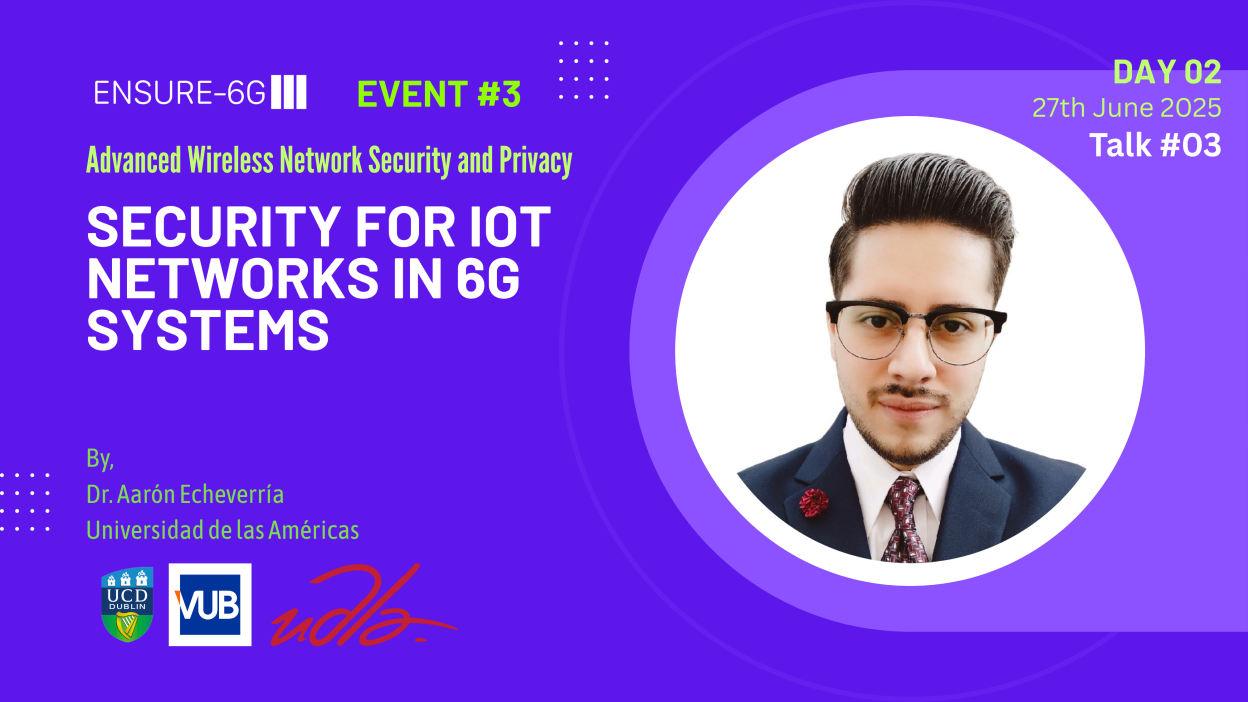
At ENSURE-6G’s 3rd event, “Advanced Wireless Network Security and Privacy,” the talk on “Security for IoT networks in 6G systems” delved into the profound cybersecurity implications of combining the Internet of Things (IoT) with the upcoming Sixth Generation (6G) wireless technology. This presentation underscored the critical need for robust security strategies to protect our increasingly interconnected world.
The Landscape: IoT Meets 6G
The Internet of Things, already connecting billions of devices from smart home gadgets to industrial sensors, facilitates a vast exchange of data and processes [00:08]. This massive connectivity is set to accelerate with 6G networks, projected to be 100 times faster than 5G and capable of supporting 10 million devices per square kilometer with ultra-dense connectivity by around 2030 [00:42]. While this convergence promises transformative power, it simultaneously introduces monumental cybersecurity risks, including an expanded attack surface, network compromise through weak devices, and cascading failures across interconnected systems [01:22].
Understanding Core IoT Security Risks
The talk highlighted several fundamental security vulnerabilities inherent in many IoT devices:
- Limited Resources: Many IoT devices possess low processing power and memory, restricting their ability to implement sophisticated security features like advanced encryption or real-time threat detection [01:52].
- Poor Authentication: A pervasive issue is the use of default or weak passwords that are rarely, if ever, changed (e.g., “admin/admin,” “1234”) [02:14].
- Inadequate Protection: Devices often transmit sensitive data without encryption, leaving it exposed. Unprotected interfaces (such as USB, HTTP, Telnet, or open ports) further create exploitable entry points [02:33].
These weaknesses make IoT networks susceptible to various attacks, including botnets for large-scale Distributed Denial of Service (DDoS) attacks, spoofing to gain unauthorized access, sniffing unencrypted sensitive data, and firmware tampering to insert backdoors or disable security features [02:55, 03:51].
Essential Security Strategies
To counter these threats, the presentation outlined crucial security strategies:
- Zero Trust Architecture: Embracing the principle of “Never trust, always verify,” this architecture emphasizes least privilege, micro-segmentation, and continuous monitoring [04:14].
- Adherence to Security Standards and Regulations: Following established guidelines from organizations like ETSI (consumer IoT), NIST (IoT capabilities), and ISO (reference architecture) is vital [04:47].
- Secure by Design: Integrating security from the earliest stages of device development—from defining requirements and conducting threat modeling in the design phase to enforcing secure coding practices in development, penetration testing, and enabling secure boot during deployment [05:08].
The Future of IoT and 6G Security
Looking ahead, the talk pointed to advanced technologies that will be pivotal for securing IoT in 6G systems:
- Quantum Key Distribution (QKD): Offering ultra-secure communication to combat threats from quantum computing [05:46].
- Blockchain: Introducing decentralization, transparency, and immutability for enhanced security [06:06].
- Self-Healing Systems: Autonomous defense mechanisms will be necessary as attacks become increasingly sophisticated [06:18].
Key Recommendations for a Secure Future
The presentation concluded with actionable recommendations:
- Integrate Security from the Start: Make “security by design” a core principle [06:31].
- Enable Automatic Updates: Keep all systems patched and up-to-date [06:31].
- Implement Network Segmentation: Isolate different parts of the network to contain breaches [06:31].
- Leverage AI for Monitoring: Use AI to analyze device behavior and data flow, as manual oversight is insufficient for complex networks [06:31].
- Prioritize User Education: Recognizing that human error is a major vulnerability, educating users and administrators on best practices is crucial [06:42].
Ultimately, ensuring security in the IoT-enabled 6G future requires standard compliance, continuous innovation, real-time AI-powered monitoring, and robust user education. Security is not an option but a fundamental requirement, where prevention is always more cost-effective than recovery, and collaboration across the entire ecosystem is paramount [08:00, 08:08].
You can watch the full recorded talk here: Security for IoT networks in 6G systems