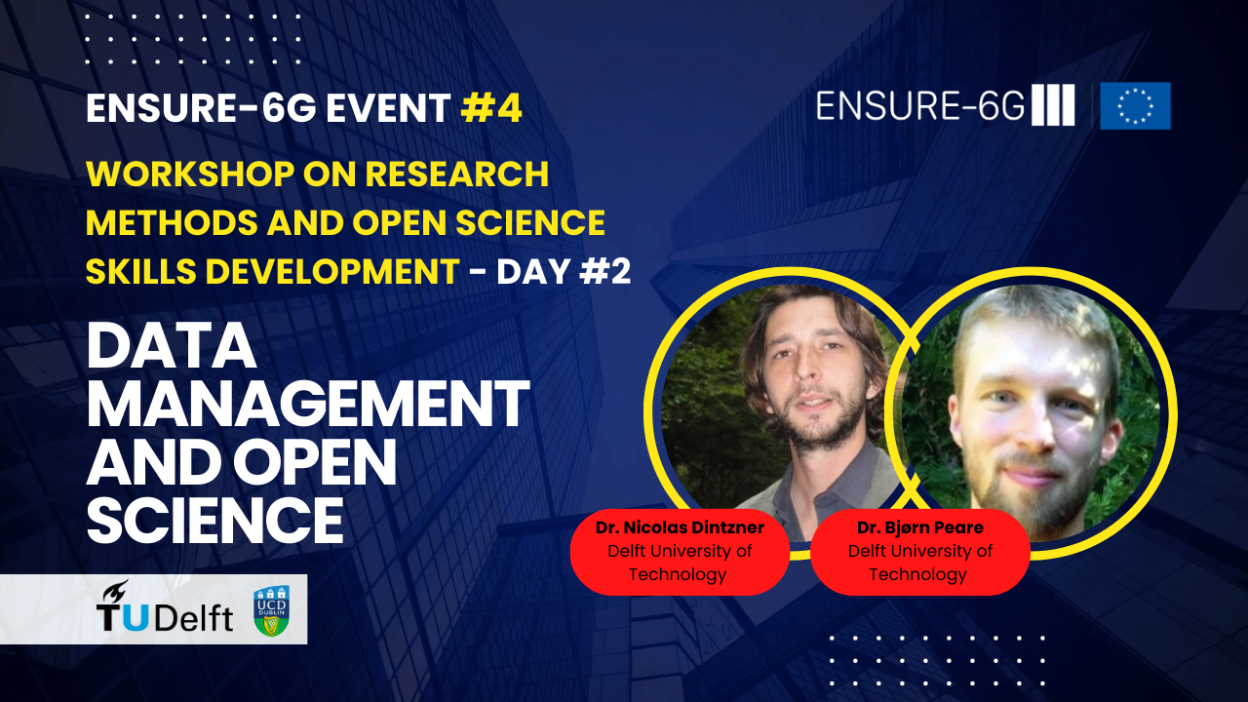
This blog post is based on the ENSURE-6G Event #4 – Day 2, specifically the “Data Management and Open Science” session. This workshop, titled “Workshop on Research Methods and Open Science Skills Development,” featured insightful presentations from Dr. Nicolas Dintzner and Dr. Bjørn Peare, both from Delft University of Technology. Their discussions highlighted the critical importance of proper data management and the principles of open science in academic research.
The Importance of Data Management in Research
The session began with Dr. Nicolas Dintzner, a data steward at TU Delft, emphasizing that research data is a shared resource that must be properly organized, stored, and accessible to relevant parties [03:48]. He stressed that having a single person as the sole custodian of data is a major risk, as it could hinder a project’s continuity if that person is unavailable [04:10]. Dr. Dintzner also advised that, as a general rule, research material should be stored within the institution’s infrastructure [04:56].
Dr. Dintzner outlined several critical aspects of data management:
- Storage and Access: Researchers are responsible for finding the right storage location for their digital material and managing access rights [05:16]. While institutions provide support, researchers are the primary custodians of their data.
- Security: There are increasing security measures and rules regarding data storage. It’s crucial for collaborators from different institutions to agree on security protocols, as not all institutions have the same rules [05:32].
- Data Provenance: It is becoming increasingly important to track the origin of data and the conditions under which it was acquired [07:25]. This is essential for transparency and for checking the legality of data reuse.
- Intellectual Property (IP): Research data and code belong to the institution, not the individual researcher, especially for employees like PhD students in the Netherlands [20:34]. This means researchers must plan in advance what materials they can take with them when they change institutions.
Navigating the World of Open Science
The second part of the session, led by Dr. Bjørn Peare, an open science co-manager at TU Delft, focused on the principles and practices of open science. Dr. Peare began by referencing the Universal Declaration of Human Rights, which states that everyone has the right to share in scientific advancement and its benefits [37:41].
Key takeaways on open science included:
- Beyond Open Access: While open access to publications is important, open science goes further. It involves sharing data, code, and experimental protocols to make research more transparent and reproducible [41:58]. Dr. Peare noted that a journal article alone is a narrative of results, while sharing data and code allows others to verify the findings and identify potential mistakes.
- Reproducibility Crisis: The presentation mentioned a survey showing that over 50% of researchers believe there is a significant reproducibility crisis in science [44:03]. To combat this, researchers must share their data and methods, as the materials and methods section of a paper is often not detailed enough.
- FAIR Principles: For data to be truly useful, it must be FAIR:
- Findable: Data should have a persistent identifier and be searchable online, often by being uploaded to a trusted repository like Zenodo or 4TU.ResearchData [50:33].
- Accessible: Data must have a communication protocol that allows it to be downloaded, even if it is not openly available.
- Interoperable: Data should use open standards and file formats (e.g., Python, R, CSV) to be easily used across different systems [51:56].
- Reusable: Data must be well-documented and accompanied by a clear license to inform others on how to reuse it [52:26].
- Licensing: The speakers recommended using a Creative Commons license, such as CC-BY, for data to ensure proper attribution. For software, an open-source license like MIT is more appropriate [54:09].
- Changing the Culture: The session concluded by discussing the “Recognition and Rewards” program in the Netherlands, which aims to credit researchers for a wider range of contributions beyond just publications, thereby fostering a culture of open science [55:58].
This ENSURE-6G event underscored that data management and open science are not just technical or legal hurdles, but fundamental pillars for ensuring the integrity, transparency, and collaborative nature of modern research, particularly within the context of advancements like 6G. The contributions from Dr. Dintzner and Dr. Peare provided valuable insights for researchers looking to navigate this evolving landscape.