

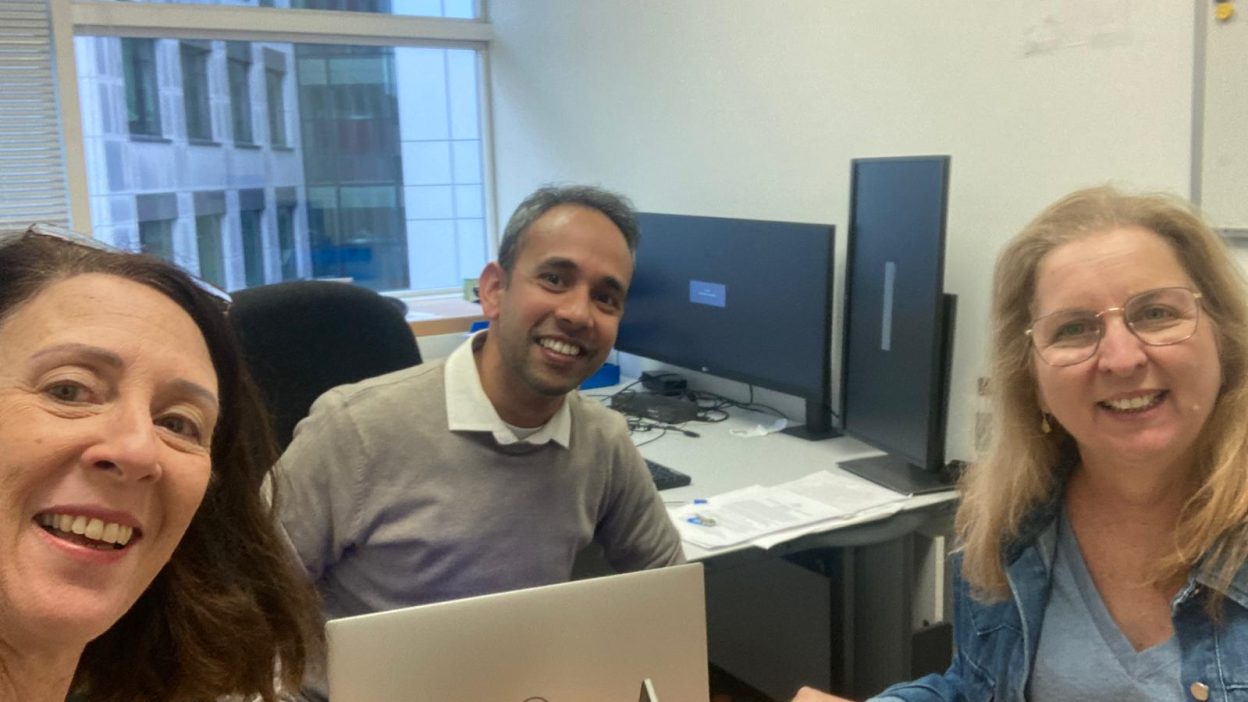
We (Dr. Galit Wellner and Dr. Hagit Meishar-Tal) recently spent a month in Dublin as visiting scholars at University College Dublin (UCD). The purpose of the visit was to develop with our host Dr. Vivek Nallur the ethical part in the joint article of deliverable 3.1 of ENSURE-6G Project, addressing privacy in 6G networks. Basically, the article is comprised of three perspectives: technological, legal and ethical. The three of us worked on the ethical and fairness aspects of privacy in AI-intensive environments of 6G networks.
The stay included in-depth theoretical discussions followed by writing sessions on how the presence of AI in future cellular networks challenges some of our basic assumptions on what it means to be human. Addressing privacy in 6G therefore requires sustained ethical engagement with questions of agency, autonomy, and responsibility at both the personal and collective levels. As 6G systems increasingly depend on continuous data collection and real-time monitoring to enable personalization, they intensify a fundamental ethical tension between the promise of tailored, adaptive services and the right to privacy. This tension is not merely individual but societal: the same data practices that support personalization also create conditions for misuse, normalization of surveillance, and asymmetric power relations, with risks of exploitation extending from personal life into social, political, and institutional domains. The Dublin discussions foregrounded the profound and far-reaching implications of an intensive reliance on surveillance-based communication infrastructures.
The discussions at UCD will probably yield two articles. One is Deliverable 3.1 that will be further developed and completed during our next secondment in Thessaloniki. The other is an additional academic paper focused exclusively on ethical aspects of privacy in 6G. We plan to submit both during 2026.
The rich discussions we developed were deeply intertwined with the people who worked alongside us, whose insights and openness enriched and propelled our thinking. These ideas were shaped through productive meetings with Dr. Vivek Nallur, and then with Prof. Madhusanka Liyanage and Mr. Charuka Moremada of UCD. We were warmly and generously hosted at the university, both professionally and personally, and the openness of our hosts created an enabling space for shared reflection and collaboration.
We also took an academic visit to Trinity College Dublin, where we met with Prof. Viet Pham and his students. We presented the project and outlined our conceptual approach to ethics and privacy in 6G networks, followed by a productive discussion with students on the ethical challenges posed by smart infrastructures, pervasive sensing, continuous connectivity, and the algorithmic shaping of public and private spaces. The dialogue with students was critical, thoughtful, and energizing, underscoring a strong interest in ethical and political frameworks that go beyond purely technical solutions.
Lastly, Dublin was utterly lovely! Its mix of history, culture, and cozy charm made every day a delight. A highlight was visiting the iconic Book of Kells at Trinity College, where the breathtakingly ornate manuscript and the atmospheric Long Room offered a glimpse into Ireland’s rich scholarly heritage. Just beside Dublin Castle, we explored the Chester Beatty Library, a remarkable museum whose world class collection of rare manuscripts and antique books spans cultures and centuries. And of course, no stay in Dublin would be complete without enjoying its wonderful pubs and traditional music and dancing.
Overall, the secondment was a period of writing, exchange, and learning and a reminder of the value of international academic collaboration grounded in trust, openness, and shared critical inquiry. The Dublin stay reinforced the understanding that ethical considerations of privacy should be seen not as an add-on, but as a core component in shaping the future of 6G networks.


