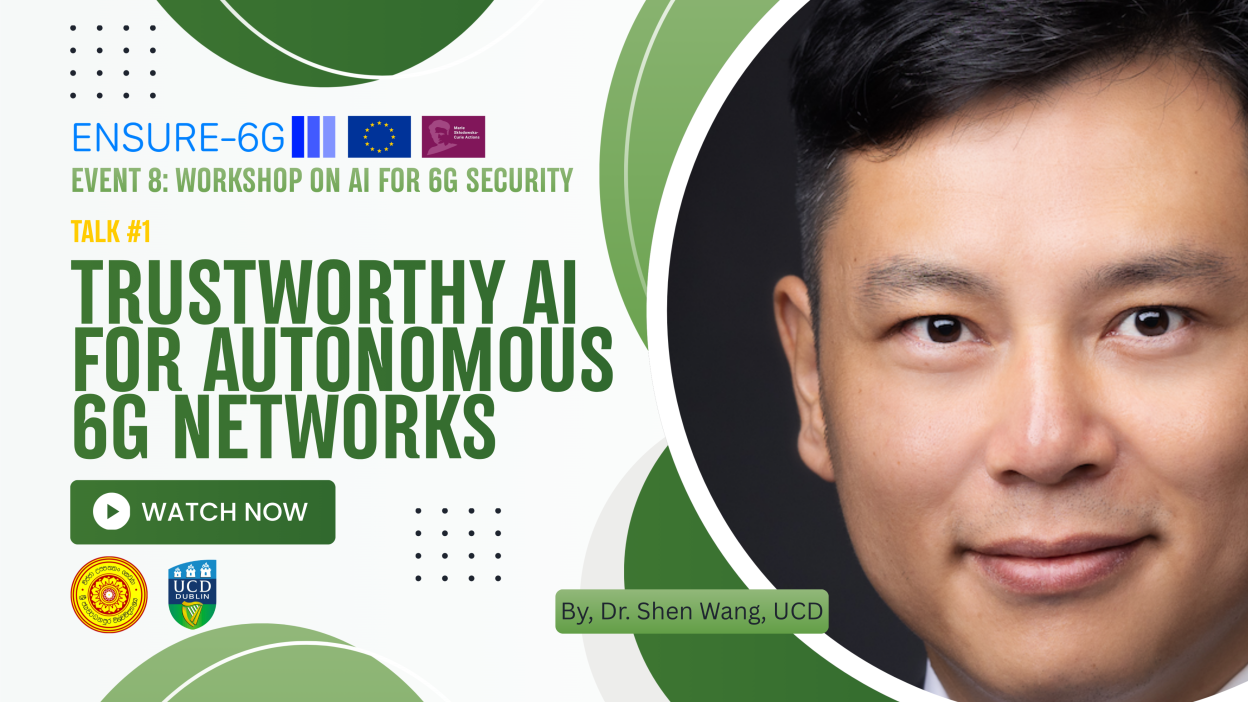
We are thrilled to share the presentation recording from our recent ENSURE-6G Event 8: Workshop on AI for 6G Security, which took place at the campus of the University of Sri Jayewardenepura (USJ), Sri Lanka.
In this session, Dr. Shen Wang, Tenure Assistant Professor and Academic Director of the Nest Lab Research Group at the School of Computer Science, University College Dublin (UCD), Ireland, delivers an insightful presentation titled “Trustworthy AI for Autonomous 6G Networks”.
About the Speaker & Nest Lab
Dr. Shen Wang ranks globally in the top 3% in both the computer science and smart cities domains. His cutting-edge research bridges artificial intelligence and distributed systems, focusing on connected autonomous vehicles, explainable AI (XAI), and security and privacy for mobile networks. As part of his talk, he introduces the rapid growth of Nest Lab—a research group closely aligned with ENSURE-6G’s vision—and the extensive research ecosystem at UCD.
Key Takeaways from the Talk
- The Evolution Toward 6G and Ubiquitous Intelligence: Dr. Wang charts the historical shift from 1G to 5G. While previous generations primarily focused on boosting communication performance metrics like latency and bandwidth, 6G steps beyond by integrating advanced artificial intelligence directly into the network control layer to enable automatic, optimal resource allocation—driving what we call ubiquitous intelligence.
- The Imperative of Explainable AI (XAI): With the incredible power of deep learning comes the risk of the “black box”. For mission-critical infrastructure like 6G networks, understanding how AI makes decisions is non-negotiable. Dr. Wang reviews fundamental XAI algorithms—including LIME, SHAP, Layer-wise Relevance Propagation, and Counterfactual XAI—and highlights how they help unbox complex machine learning models.
- Navigating Research & Legal Challenges: Implementing XAI in 6G comes with hurdles. Researchers face the strict challenge of balancing the trade-off between model utility (power) and explainability. Furthermore, AI deployments must satisfy strict legal frameworks like the GDPR and the EU AI Act, ensuring high-risk AI deployments are rigorously audited and transparent.
- Real-World Applications in 6G Security: Drawing from EU project implementations, Dr. Wang demonstrates how XAI can be used practically to identify network traffic anomalies and adversarial security risks. For instance, XAI explanation shifts can alert system administrators if a model is undergoing an evasion or data-poisoning attack. He also introduces SHAP-refine, a method to filter out volatile features, making AI models significantly more resilient to attacks while preserving high prediction utility.
- Securing the Explanations (Adversarial XAI): In a fascinating twist, the presentation covers how XAI algorithms themselves can be targets of spoofing attacks. Sophisticated attackers can manipulate models to output “unbiased-looking” XAI explanations while hiding underlying algorithmic biases, a crucial threat vector that network security teams must prepare for.
Watch the full presentation video below: