

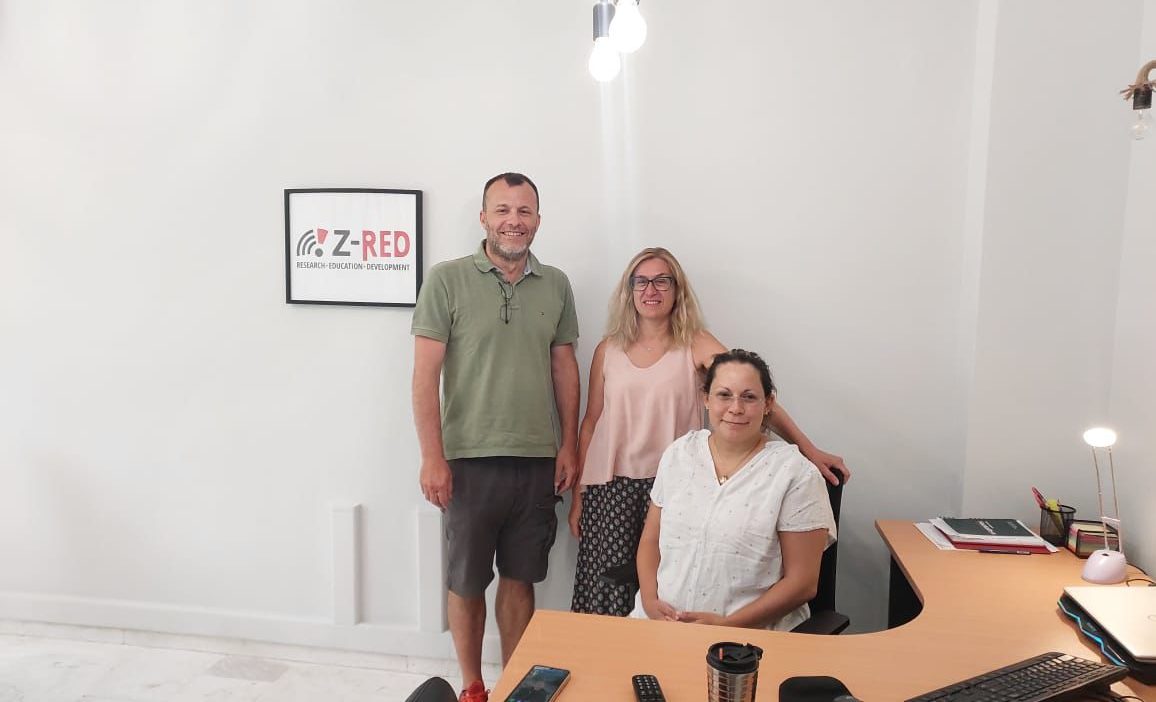
During 2025, Dr Elisavet Andrikopoulou undertook a two-part secondment at Z-RED. The secondment took place over two weeks in late July–early August 2025, followed by two weeks in late October–early November 2025, enabling a “from-scoping-to-output” cycle: first, exploring and shaping the research direction, and second, consolidating the work into a co-authored publication.
The initial visit focused on exploring how AI-native 6G capabilities (e.g., real-time connectivity, distributed intelligence across edge–cloud, and autonomy) intersect with healthcare safety, privacy, and governance requirements. Joint discussions with Z-RED helped translate broad “trustworthy AI” aims into concrete questions that matter in clinical settings, especially where latency, reliability, and accountability become safety critical.
Dr Katerina Kanta was also present during this first visit, which helped accelerate shared conceptual framing and shaped a collaboration between four co-authors (Dr Andrikopoulou, Eirini Kanaki, Prof Periklis Chatzimisios, and Dr Katerina Kanta).
The second visit was dedicated to turning the scoping work into a conference paper: “Aligning AI and 6G with EU Ethical and Legal Frameworks for Healthcare.” The paper has been accepted for publication in EFMI MIE 2026 conference.
The paper focuses on how key EU instruments, such as GDPR, the EU AI Act, NIS2, and the Medical Device Regulation, can be treated as practical design and validation constraints for 6G-enabled healthcare systems, rather than “after-the-fact” compliance checks.
To ground the discussion in realistic clinical contexts, the work uses three illustrative scenarios:
- Remote robotic surgery (safety, latency, liability, cybersecurity assurance)
- Real-time remote patient monitoring (consent, autonomy, continuous data processing, governance)
- Emergency telemedicine (time-critical decision-making, presumed consent, equity and infrastructure gaps)
Overall, the secondment strengthened the bridge between technical network/AI design and health informatics governance, with an emphasis on compliance-by-design and ethically robust validation thinking for high-stakes healthcare deployment. The outputs feed into ENSURE-6G’s wider efforts on trustworthy and regulation-aligned security, privacy, and validation approaches.
Dr Andrikopoulou thanks Z-RED for their hospitality and close collaboration, particularly Eirini Kanaki and Periklis Chatzimisios for hosting and supporting the secondment activities, alongside the wider ENSURE-6G consortium for enabling these exchanges.


