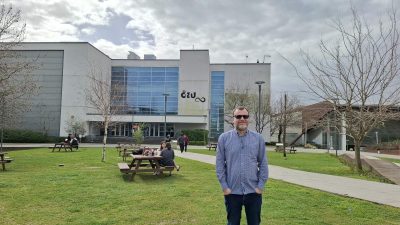
As part of the ENSURE-6G research and innovation programme, the second month of my secondment at Z-RED L.P. was completed from 9 December 2025 to 8 January 2026. Building on the first phase, which focused on developing the conceptual and methodological foundations for energy-aware trustworthy AI in 6G security, this second phase moved towards the preliminary practical exploration of the proposed framework.
The work continued to contribute directly to Work Package 3 (WP3) – Innovative privacy solutions for 6G with legal and ethical consideration, and more specifically to Task 3.1, which addresses privacy-preserving and ethically compliant AI/ML-enabled intrusion detection systems. Within this context, the second month focused on examining how key requirements such as privacy, fairness, explainability, and energy efficiency can be operationalised in AI-driven network security settings, including distributed and federated learning environments.
Moving Towards Prototype-Level Exploration
During this phase, the main objective was to translate the conceptual framework developed in the first month into early-stage experimental workflows. A prototype-level environment was set up to support the preliminary investigation of how different design parameters may influence model behaviour, detection performance, and resource usage in AI-based intrusion detection. This enabled an initial exploration of the interaction between privacy, fairness, and energy-related considerations, rather than treating them as separate concerns. The experimental workflows were intentionally exploratory. Their purpose was to support the practical interpretation of the framework, identify implementation challenges, and highlight areas requiring further refinement. This provided a bridge between high-level trustworthy AI principles and their possible technical realisation in operational 6G security environments.
Refining Requirements for Practical Implementation
In parallel, the requirements defined during the first month were revisited and clarified, with additional attention given to their interpretation in practical settings. The mapping to relevant legal, ethical, and standardisation frameworks, including the General Data Protection Regulation (GDPR), the EU AI Act, and IEEE standards, was maintained and incrementally refined. This helped strengthen the connection between regulatory principles and technical safeguards, supporting a compliance-by-design approach.
The collaboration with Z-RED continued to provide valuable interdisciplinary input throughout the second month. Z-RED’s applied research perspective, with its emphasis on ethical design, sustainability, and human-centred AI, supported the refinement of the framework from both technical and practical viewpoints. Regular exchanges helped connect academic research objectives with industry-oriented considerations, particularly around usability and real-world applicability.
Towards Validation in 6G Security Scenarios
Overall, the second phase contributed to ENSURE-6G Task 3.1 by supporting the transition from conceptual modelling to early-stage practical exploration. The outcomes provide a useful basis for future work, including further refinement of the experimental workflows, broader exploration across representative 6G scenarios, and continued development of mechanisms for assessing trustworthy and energy-aware AI in 6G security infrastructures.
Contributed by Dr. Adamantios Bampoulas, University College Dublin (UCD),
in collaboration with Z-RED L.P., under Work Package 3 (Task 3.1).