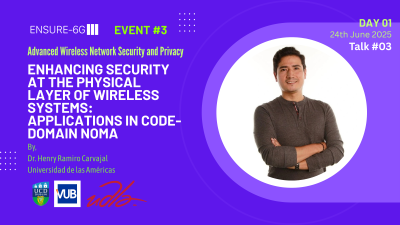
At ENSURE-6G’s 3rd event, “Advanced Wireless Network Security and Privacy,” Dr. Chamitha De Alwis delivered an illuminating talk on “Security in the IoT ecosystems and next-generation networks.” This presentation shed light on the evolving security landscape of 6G networks, highlighting the significant leap from previous generations and the new array of challenges and opportunities that lie ahead.
The Dawn of 6G: A Paradigm Shift
Dr. De Alwis began by underscoring that 6G isn’t merely an upgrade to 5G; it represents a fundamental paradigm shift. Envisioned to deliver terabit-per-second data rates, extremely low latency (0.1 ms), unparalleled reliability, and massive connection density, 6G promises to unlock revolutionary applications such as space/deep sea tourism and holographic telepresence [03:03, 03:57]. With a projected deployment around 2030, this future network will be pervasive and highly distributed [04:22].
Navigating the Expanded Attack Surface
The comprehensive and distributed nature of 6G inevitably leads to an expanded attack surface and the emergence of novel threats [04:58]. Dr. De Alwis categorized these threats into three main areas:
- Pre-6G related issues: Inherited vulnerabilities from existing technologies like IoT and early 5G/6G test networks [06:32].
- 6G architecture threats: New risks arising from architectural elements such as tiny cells, mesh networks, and zero-touch networks [06:57].
- 6G technology threats: Security concerns stemming from enabling technologies like AI, blockchain, quantum computing, and visible light communication [07:25].
Security Challenges Across Enabling Technologies
The talk delved into specific security issues within these enabling technologies:
- Network Slicing: Vulnerabilities include lifecycle security, inter-slice security, and issues with trust and privacy [08:02].
- AI: Susceptible to model poisoning, evasion attacks, and infrastructure compromises [09:13].
- Blockchain (DTS): Risks such as 51% attacks, eclipse attacks, and end-user vulnerabilities [09:30].
- Quantum Communication: Threats like quantum cloning and areas not yet fully understood, such as quantum entanglement [09:45].
- Terahertz and Visible Light Communication (VLC): Prone to access control attacks, eavesdropping, and jamming (especially VLC) [10:16].
These vulnerabilities extend across all 6G architectural layers, from the intelligent sensing layer with its weak cryptography and rogue IoT devices [11:02], to the intelligent edge layer facing physical security threats and DoS attacks [11:14], and up to the application layer with data privacy concerns and potential 51% attacks on blockchain applications [12:22].
Solutions and Research Directions
Dr. De Alwis highlighted several critical areas of research and solutions for 6G security:
- AI for Security and Security for AI: AI serves as both an enabler (automating security tasks, anomaly detection) and a defender, but also poses risks when used by adversaries or as a target itself [15:28].
- Explainable AI (XAI): Crucial for understanding and trusting AI decision-making in security, applicable across all 6G network layers [18:13].
- Blockchain: Offers advantages for enhancing security in areas like zero-energy IoT, despite ongoing challenges [20:25].
- Quantum Computing: Research focuses on post-quantum cryptography, quantum-resistant hardware, and quantum-assisted communications to build quantum-safe 6G [22:16].
- Physical Layer Security: New challenges and solutions are emerging with intelligent surfaces, VLC, and even molecular communication [23:54].
IoT Security in Critical Infrastructure
A significant part of the discussion focused on the unique security challenges presented by IoT devices, particularly their integration into critical infrastructure. IoT devices often have limited power and processing capabilities, making robust security a challenge [30:24]. The need for lightweight security mechanisms is paramount, as complex security measures can drastically reduce battery life [33:48]. The concept of “small data” in IoT—recent, relevant data requiring immediate decision-making—also introduces security challenges due to the limited time for verification [35:30].
The talk concluded by emphasizing that while these technologies offer promising solutions, they also introduce their own set of vulnerabilities. Securing 6G will require a complex and active research effort to ensure the integrity and resilience of our future networks.
You can watch the full recorded talk here: Security in the IoT ecosystems and next-generation networks