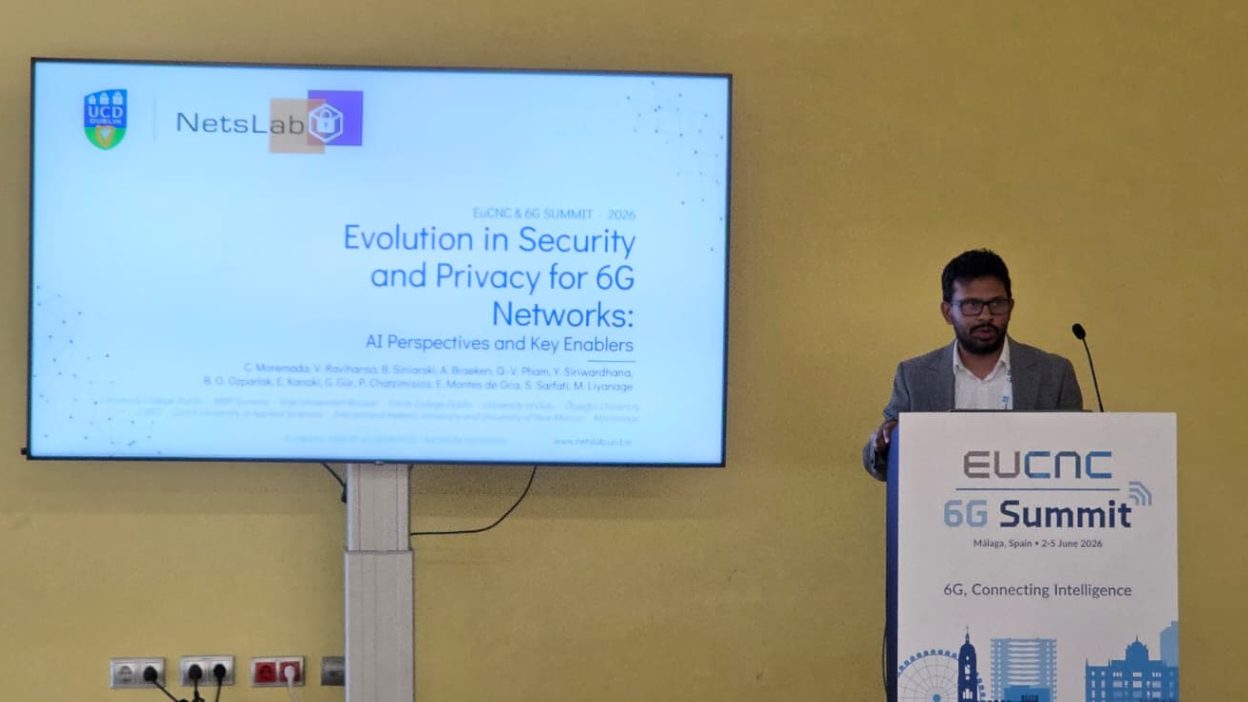
Málaga, Spain | June 2026
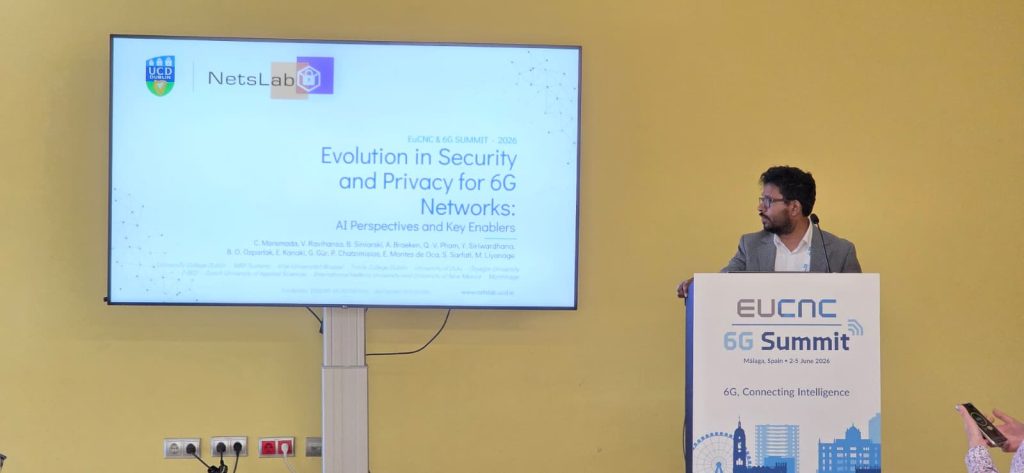
The ENSURE-6G project was proudly represented at the EuCNC & 6G Summit 2026, held in Málaga, Spain, through the presentation of the research paper “Evolution in Security and Privacy for 6G Networks: AI Perspectives and Key Enablers” by Charuka Moremada, PhD Researcher at the Network Softwarization and Security Labs (NetsLab), University College Dublin (UCD) and Project Manager of ENSURE-6G.
The paper brought together contributions from an international team of researchers and industry experts across Europe, reflecting the collaborative and multidisciplinary nature of the ENSURE-6G project. The work examines how Artificial Intelligence (AI) is reshaping the security and privacy landscape of future 6G networks while also introducing new challenges that must be addressed to ensure trustworthy and resilient communications.
Addressing Security and Privacy Challenges in AI-Native 6G Networks
As 6G networks evolve towards highly intelligent and autonomous architectures, AI is expected to become deeply integrated across network operations, enabling advanced automation, optimization, and decision-making. While these capabilities unlock new opportunities, they also create new attack surfaces and security risks.
The presented paper provides a comprehensive interdisciplinary review of AI-driven security and privacy mechanisms for future 6G networks. Key research areas discussed include:
- AI-enhanced Intrusion Detection Systems (IDS)
- Federated Learning (FL) for privacy-preserving intelligence
- Explainable Artificial Intelligence (XAI) for trustworthy network automation
- Emerging AI-driven threats and corresponding countermeasures
- Green security approaches for sustainable 6G deployments
- Legal, ethical, and regulatory considerations for AI-powered communications systems
The research emphasizes that security, privacy, sustainability, and compliance must be considered together to enable the successful deployment of future AI-native communication infrastructures.
Exploring the Role of Large Language Models in Future Intrusion Detection
One of the highlights of the paper is an experimental feasibility study investigating the use of Large Language Models (LLMs) for network intrusion detection. The study evaluated several state-of-the-art LLMs on the CIC-IDS2017 dataset to assess their ability to distinguish between benign and malicious network traffic using few-shot prompting techniques.
The results demonstrated that while conventional machine learning approaches such as Random Forest and XGBoost continue to achieve superior detection performance, LLMs show promising capabilities in identifying malicious activities and providing natural-language explanations of security events. The findings highlight the growing potential of Generative AI to enhance future security operations and improve the explainability of AI-driven defense systems.

Contributing to ENSURE-6G’s Vision
The presentation aligns closely with ENSURE-6G’s mission of developing secure, resilient, and privacy-preserving 6G ecosystems. As future networks become increasingly dependent on AI, ensuring the trustworthiness of these technologies will be critical for supporting applications such as digital healthcare, intelligent transportation, Industry 5.0, smart cities, and immersive communications.
Participation in EuCNC & 6G Summit 2026 provided an excellent platform to share research outcomes, engage with leading experts from academia and industry, and contribute to discussions shaping the future of secure 6G communications.
The ENSURE-6G consortium continues to advance research and innovation at the intersection of AI, cybersecurity, privacy, trust management, and next-generation networking, helping pave the way towards a safer and more trustworthy 6G future.
Acknowledgement
This research was partially supported by the European Union under the ENSURE-6G Project (Grant Agreement No. 101182933) and represents a collaborative effort involving researchers from academia and industry across multiple countries.