

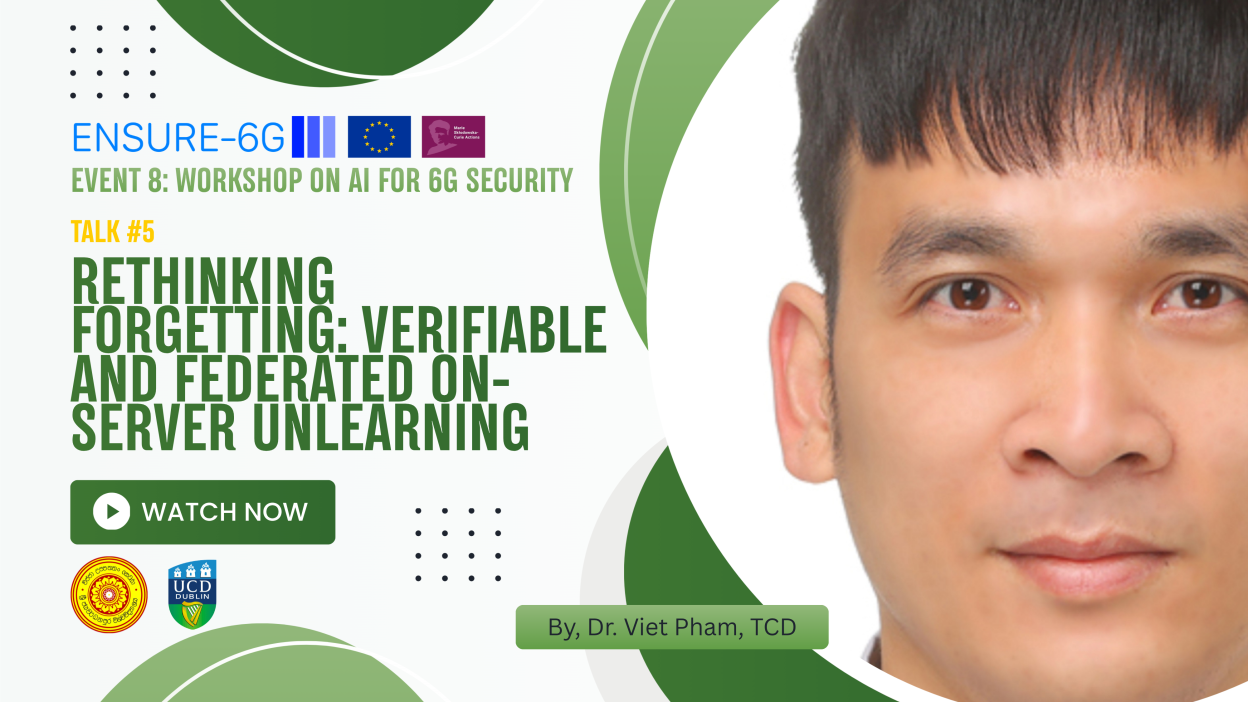
We are pleased to share the presentation recording from Talk #5—the final session—of our ENSURE-6G Event 8: Workshop on AI for 6G Security, which concluded at the University of Sri Jayewardenepura (USJ), Sri Lanka.
In this talk, Dr. Viet Pham, Associate Professor in Network and Distributed Systems at the School of Computer Science and Statistics, Trinity College Dublin (TCD), Ireland, presents a groundbreaking look into data deletion in machine learning, titled “Rethinking Forgetting: Verifiable and Federated On-Server Unlearning”.
About the Speaker & Academic Ecosystem
Dr. Viet Pham is a highly recognized researcher, having received the Clarivate Highly Cited Researcher Award in 2024 and the IEEE ComSoc Best Young Researcher Award for EMEA in 2023. His research sits at the intersection of wireless AI, edge computing, distributed machine learning, and 6G networks. As part of his talk, he showcases the deep research ecosystem at TCD, a historical university ranking 75th globally (QS World Rankings) and hosting major national research centers in AI and telecommunications.
Key Takeaways from the Talk
- The Privacy and Legal Mandate to “Forget”: With major modern legislative frameworks like the GDPR and CCPA actively enforced, consumers possess a legal “Right to be Forgotten”. In distributed systems or Federated Learning (FL)—where millions of edge nodes contribute data updates to a global system—service providers must guarantee that a user’s data influence can be fully expunged from deployed AI models upon request.
- The Gaps in Existing Machine Unlearning: Dr. Pham identifies two massive gaps in existing machine unlearning frameworks:
- Retraining from Scratch: While technically sound, completely wiping a global model and retraining it from zero whenever a client leaves is computationally exhausting and fundamentally impractical for large-scale production networks.
- Approximate Unlearning: While exceptionally fast, approximate methods are narrow in scope and often cause a severe reduction in model accuracy.
- The Verification Crisis: Crucially, there is currently no trusted way for an end-user to mathematically verify that a company has actually scrubbed their data’s footprint from an AI model.
- A Trust-by-Design Verifiable Architecture: To resolve the verification problem, Dr. Pham details a newly proposed positioning framework that maps exactly who unlearns, who verifies, and what metrics can be used by third-party auditors to ensure data trace removal has occurred successfully.
- Disentangling Invariant (Causal) vs. Variant Components: To streamline on-server unlearning without sacrificing accuracy, the core research introduces a model splitting approach. Using an auto-encoder model setup, the framework divides information into two tracks:
- Invariant (Causal) Features: Broad, stable data realities that do not belong to one specific user (e.g., “Dublin is the capital of Ireland”). This data is public, non-sensitive, and does not require forgetting.
- Variant (Non-Causal) Features: Highly sensitive, user-specific data features that must be separated and unlearned when requested.
- Leveraging High School Trigonometry for Gradient Alignment: A primary challenge in scaling unlearning across millions of clients is aligning conflicting objectives on a central server. Dr. Pham presents an elegant solution using high school cosine angles. By treating model updates as mathematical angles, the server actively optimizes to minimize the gradient angle for retaining clients (approaching 0° for max retention) and maximize the gradient angle for forgetting clients (approaching 90° for absolute removal).
- Proven Performance and High Utility: Benchmark experiments demonstrate that this joint optimization approach successfully achieves a massive utility gap between retaining and forgetting clients. It consistently outperforms existing baselines, maintaining exceptionally high retaining accuracy while successfully removing sensitive data paths within a fraction of the time required by traditional model retraining.
Watch the full presentation video below:


